





BLOGSDETAILS
Is 2‑piece lure rod strong enough for big fish?
Author:cangfeng Time:2026-08-24 15:17:24 Click:186
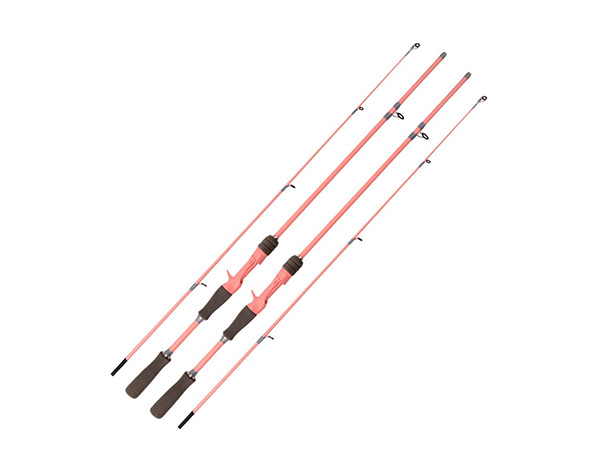
A well‑made two‑piece lure rodcan handle big fish,yet strength depends on blank power,ferrule quality and proper operation,not simply the two‑piece design itself.Poor‑quality two‑piece rods will fail under large‑fish loads,while premium two‑piece models deliver performance near one‑piece rods.
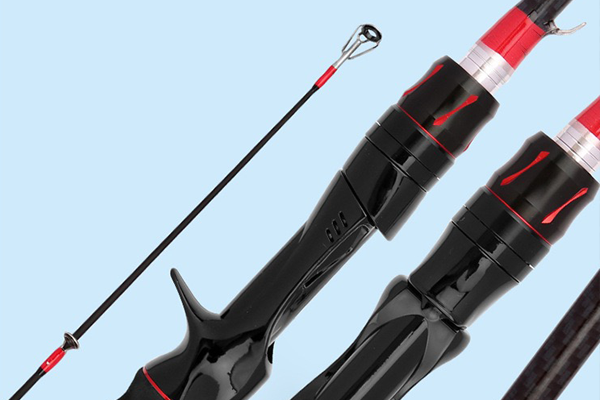
The spigot joint is the critical area.High‑grade two‑piece rods use precisely‑machined reinforced spigot ferrules.Carbon layers are thickened around the joint to distribute bending stress evenly.When assembled fully tight,the blank forms a smooth bending arc,and breakage usually occurs on the main shaft instead of at the joint.Medium‑heavy and heavy‑power two‑piece lure rods are factory‑rated for large predators such as big pike,trophy bass,inshore grouper and striped bass.
However,low‑cost two‑piece rods come with significant risks.Loose‑fitting,poorly machined ferrules create stress concentration.During hard fights,sudden surges from big fish produce sharp hinge‑style bending at the joint,which may crack or snap the blank.Even if static load tests pass,repeated dynamic shocks gradually cause fatigue damage at the ferrule.
Real‑world conditions greatly affect performance with big fish:
1.Assembly must be complete:Push the spigot firmly home before fishing.Slightly loose joints will shift under load and become failure points.Check joint tightness regularly during long‑time fishing trips.
2.Stay within rod power rating:Do not use a medium‑power two‑piece rod for oversized fish that require heavy‑duty power.Match rod power to target size.
3.Avoid extreme leverage angles:Do not crank the rod straight back past 90‑degree.Keep fighting angle around 45‑60 degrees.Over‑angling multiplies stress on the ferrule when big fish surge.
4.Play fish properly:Do not brute‑force haul huge fish straight out of heavy cover or reefs.Use reel drag to absorb powerful runs,reduce sudden shock loads transferred to the two‑piece joint.
Limitations compared with one‑piece rods:
Even good two‑piece rods have slight discontinuity at the ferrule.Under continuous heavy‑duty abuse,joints accumulate fatigue faster than solid one‑piece blanks.For tournament‑level big‑fish angling,most professionals still choose one‑piece rods for maximum reliability.Two‑piece rods are excellent for recreational use,but not ideal for relentless offshore big‑game battles.
Practical advice:
-For freshwater large pike,big bass,catfish and inshore saltwater species:quality medium‑heavy/heavy two‑piece lure rods are fully adequate.
-For giant reef grouper,GT and offshore big‑game:prefer one‑piece or high‑end multi‑section travel rods built for big‑game,not ordinary two‑piece lure rods.
-Inspect the ferrule surface for scratches,whitening or cracks after fighting large fish.Stop using if damage appears.
In conclusion:Good‑quality two‑piece lure rods with proper power and solid spigot joints are strong enough for most big‑fish recreational angling.Budget two‑piece models carry higher break risk.Success relies on matching rod power to fish size,correct assembly and smart fish‑playing technique,rather than brute forcing against maximum limits.
References
GB/T 7714‑2015
Kowalski M,Baran R.Numerical‑experimental approach to assess the deflection behaviour of carbon fibre fishing rod[J].Journal of Sports Engineering and Technology,2020,234(2‑3):112‑121.
APA 7th Edition
Kowalski,M.,&Baran,R.(2020).Numerical‑experimental approach to assess the deflection behaviour of carbon fibre fishing rod.Journal of Sports Engineering and Technology,234(2‑3),112‑121.
MLA 9th Edition
Kowalski,Michal,and Ryszard Baran.“Numerical‑Experimental Approach to Assess the Deflection Behaviour of Carbon Fibre Fishing Rod.”Journal of Sports Engineering and Technology,vol.234,nos.2‑3,2020,pp.112‑121,
 HOT PRODUCT
 CONTACT US